Culture

Beer Language School

Beer

Beer… something I know.

The German language … something I don’t know. The key to learning something new is to relate what you don’t know to what you do know. Germans love their beer … so what better way to learn their language?

Many English words for beer come from German, so we can use this knowledge as a starting point. Though it’s spelled differently, both languages use the same word – beer or Bier (Why did I capitalize it? See below!) – to describe this much-loved beverage. So the good news is… even if you don’t know any German at all, you can always order one of these frosty drinks!

Here are a few things you can learn at Beer Language School:

Bier

The word Bier teaches us two things about the German language: First, all nouns are capitalized in German, not just proper nouns. (But the pronoun ‘I‘ (ich) isn’t capitalized. What does that tell you about German priorities?) Next, when it comes to pronunciation, if two vowels are ‘walking’ … the second vowel does the talking. For instance, in the word Bier, the ‘e‘ sound is pronounced. Check out the next word to see what I mean…

Weiss

This is the German word for white.  It’s pronounced Vice.  The second vowel (i) does the talking.  Weiss also teaches us one more thing: W in German is pronounced like a V.  What about V?  It’s pronounced like an F.  What about F?  It’s pronounced like an F!!!   (I didn’t say this would be easy!)

Never heard of Weissbier?  You may have heard it called Hefeweizen (literally yeast wheat).

Lager

This word comes from the German word lagern, which means to store. Beer was invented before refrigerators, so beer was often brewed in the winter and then stored in a cool place until summer. Now you know your first German verb! Lagern, to store. Let’s try a couple of adjectives…
IMG_1431

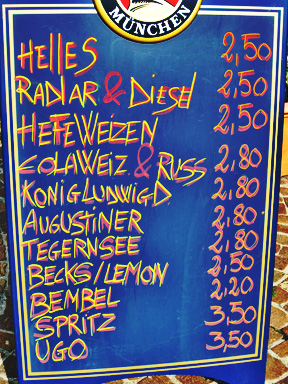
Helles

If you curse while you’re drinking, be aware that if you say “Hell!’ you might end up with another beer in your hands. Hell is the German word for light, and it’s often used to refer to a light beer.

Dunkel

If you prefer darker beers, then you probably know the word Dunkel … the German word for dark. The letter ‘u’ is pronounced differently in German. If you want to sound like a true German, don’t pronounce it  ‘dunk-el,’ say ‘doonk-el.”

Stein

No discussion of German beer would be complete without mentioning a beer stein! Stein is the German word for stone. It shouldn’t come as a surprise that Steins are a type of stoneware. But wait – there’s more! There is also a type of beer called Steinbier. It’s made by dropping hot stones into the brew. If you come across one of these, give it a try – this type of beer is becoming quite rare!

You’ve completed you first lesson at Beer Language School! You now know the German words for beer, white, light, dark, stone, and to store. You also learned some pronunciation tips and even a little history.

Not planning a trip to Germany? Oh well – at least this weekend you can impress your friends. (But if you’re not in Germany and you decide to say “Hell!” to your server… better watch out!)

By the way …  there’s actually a German Beer Institute if you want to learn more!

5 Funny German Words

5 More Funny German Words

Standard
Culture

A Piggy Peep Show

Need some good luck this year?  Grab a pig!  In Germany and many other parts of the world, pigs are considered good luck. Fresh out of swiney charms? I’ll show you a place where you can find over 40,000!

The place is called the Stuttgart Schweine Museum. According to the Guinness Book of World Records it boasts the much-coveted honor of being the world’s largest Pig Museum.

With a place like this, who needs the Louvre?

The Mona Lisa’s got nothing on this:

IMG_5842

Then there’s the Statue of Pigerty:

IMG_5850

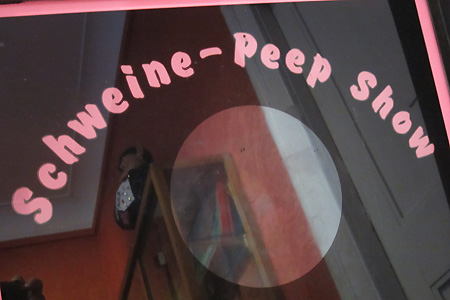
And the Piggy Peep Show:

IMG_5843

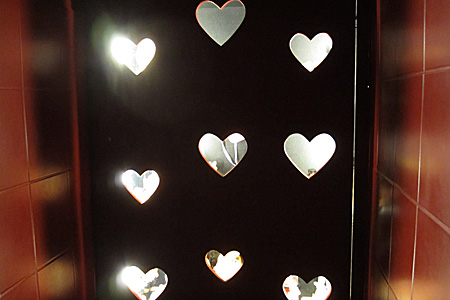
Duck inside this secret room and peek through the heart-shaped windows to see piggies in compromising positions. According to the exhibit, the German word Schweinkram means “nasty stuff.” Pigs have long been associated with fertility and all that goes with it. Pigs also have a reputation for being “dirty.”

IMG_5859

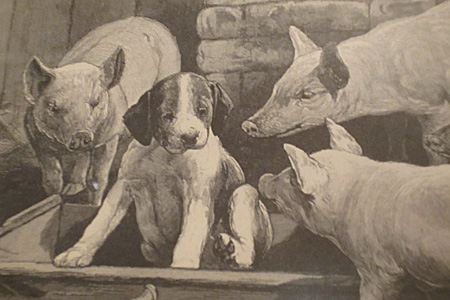
The museum is educational, too. You can learn about the theory of Evolution:

IMG_5877

Or learn how to say ‘pig’  in multiple languages, including the ever useful Morse code:

IMG_5861

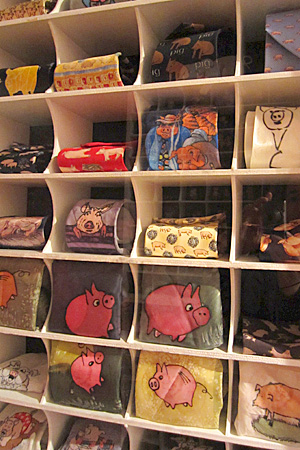
The museum has something for everyone, including ties for dad:

IMG_5874

Stuffed animals for the kids (the museum claims plush pigs were invented 10 years before the teddy bear):

IMG_5872

And for mom, there are plenty of goodies for bed, bath, and beyond…

IMG_5866

There’s serious art, too:

IMG_5837

And of course, no pig museum worth it’s bacon would be complete without piggie banks:

IMG_5845

If you visit, be careful what you say. This is a place where pigs really do fly:

IMG_5886

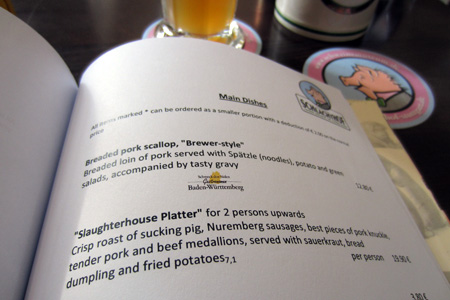
And if you work up an appetite exploring all 29 rooms, the museum has a restaurant. The food is actually quite good if you can get past some of the menu descriptions. (What are the best pieces of pork knuckle?)

IMG_5890

Some final thoughts by Sir Winston Churchill:

“I like pigs. Dogs look up to us. Cats look down on us. Pigs treat us as equals.”

IMG_5870

More Piggy Posts:

Stop Sausaging Around

Happy Yellow Pig Day

Standard
Life

Drying Rack Love

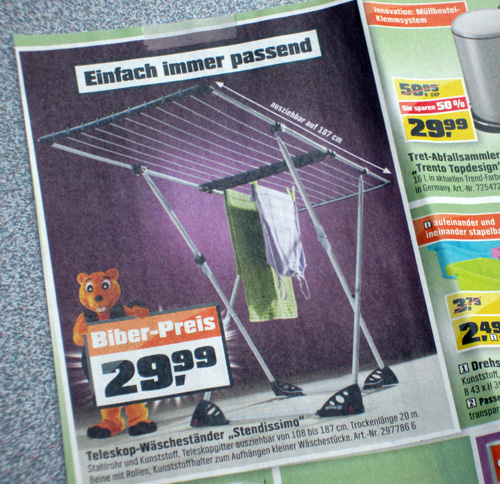
Drying racks are featured in every circular, ranging from cheap to the very high end.

When you move to a foreign country, you assume it’ll be the big things that are difficult to deal with…like grappling with a new language, struggling to find your way around, and adjusting to a diet composed primarily of sausage.

But it’s not.

It’s the little things that make you crazy.

Like doing laundry.

A simple, ordinary, everyday thing…

What do you mean I can’t use my good, old USofA laundry soap? Just how long is the laundry going to take, anyway? It’s been in there two hours!

And what is that thing on the dryer…the drawer with the water in it? How come the dryer starts and stops as many times as a bread machine? Cupboard setting? What is that? And most importantly…

Why are all those metal racks standing around the laundry room in yoga poses???

Doing laundry in Europe is…needless to say…different. For starters, laundry washing is a communal event. In our apartment building, everyone puts their machines in a central location…the basement. I haven’t seen that since my dorm room in college.

If you use the soap we’re used to in the States, the suds will float the entire apartment complex down the street. The clothes are in there for at least half a day, and the dryer isn’t a dryer in the literal sense of the word. It’s a steamer. Instead of venting to the outside, a condenser collects the moisture in a drawer that must be emptied after each load.

And in place of  the settings we’re used to…Dry, Super Dry, and “So-Dry-The-Clothes-Incinerate,” European dryers have settings like “Cupboard.” This means the clothes come out slightly more steamed than if you had selected “Iron.” But they’re not dry. Not even close.

Hence the drying rack.

These long metal racks with wings adorn every porch and yard across Germany. After steaming your clothes for a couple of hours, you must hang them on the rack to do the actual drying. When I first moved here, I was not happy about this. Not having the ubiquitous drying rack, I was forced to hang my damp clothes from the lamps, the TV…whatever happened to be handy.

Then one day my dryer broke (Oh, you’re supposed to clean the condenser-thingy?) and I was forced to conform to the drying rack lifestyle.  Luckily, the jet engine spin cycle on the washer squeezes every last drop of water out of the clothes. So with the dryer broken, I just took the clothes out of the washer and hung them directly on the rack. I discovered a shocking thing…they dried just as fast. I’m a lazy person, so now…even though I have a bright, shiny new dryer down in the laundry room…I’ve decided that steaming is an unnecessary step.

I’ve been converted. In fact, when I move back home, I’m going to bring 20 drying racks with me and give them to all of my friends. It’s finally happened. I’ve fallen victim to…

Drying rack love.

Standard
Travel

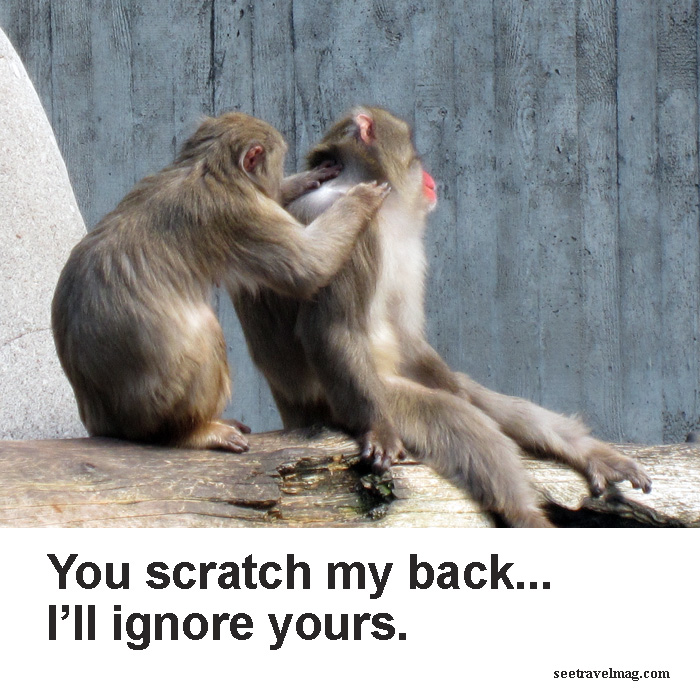
Travel Funnies 2

A little humor to brighten your Friday…


Feel free to copy and share!

“Like” my facebook page to see photos as soon as they’re published!

Standard
Travel

Travel Funnies

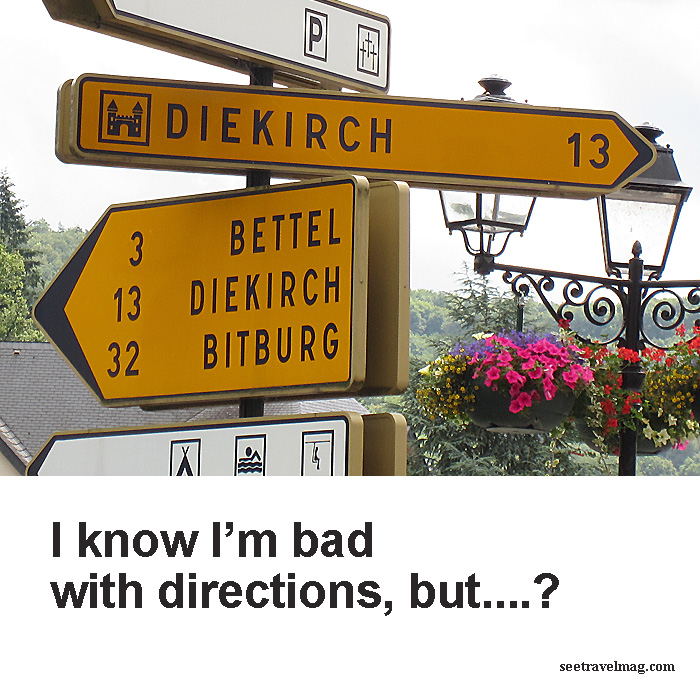
When you travel to new places, you can’t help but notice things that seem…well…different. Some things tickle my funny bone, so I’ve decided to share them here. If any strike your fancy, feel free to copy and share!


Want more? “Like” my facebook page to see photos as soon as they’re published!

Standard