Travel

Castle of the Weird and Wild

If there’s one thing Germany does not have a shortage of… it’s castles. Nearly every place on the map has a relic perched on a nearby hill or crowning the center of town.

One thing I’ve discovered since my first castle tour is that every castle is unique in an often weird and wild way. But the castle I visited the other day takes the cake.

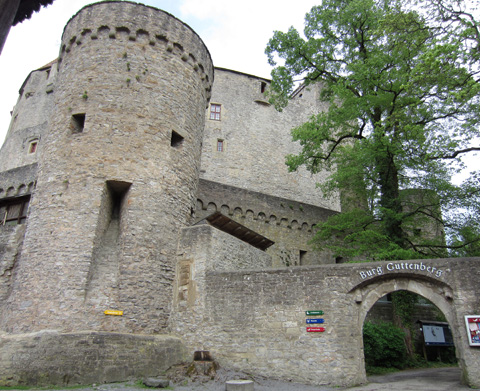
The Guttenberg Castle is located in the Neckar Valley about an hour from Stuttgart. The castle was built around 800 years ago to protect an imperial palace located in the nearby town of Bad Wimpfen.

Ownership of the castle changed hands over time until it was converted into the present day museum. But the legacy of the colorful previous owners of the castle still linger.

Take these hunting trophies that adorn the library…

Now, I don’t know about you, but these are unlike any hunting trophies I have ever seen. There is only one word to describe them…weird. I mean, what exactly are they supposed to be?

Medieval emoticons?

Laugh Tongue

Then there’s the matter of the castle’s torture chamber…

When you leisurely stroll through the museum and stumble into this room, as if suddenly seeing pictures of people being tortured isn’t creepy enough, your presence trips an invisible sensor and you’re treated to a medley of torture chamber sound effects…just perfect for a nice Sunday in the country.

As for the castle’s wild side, the Guttenberg Castle presents a daily raptor show featuring some very deadly predators. This program is not a watered-down we’re-afraid-of-getting-sued animal show. In fact, if you’re faint of heart, this show might not be for you.
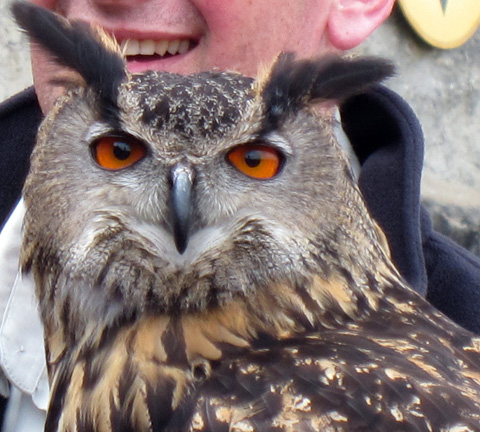
The trainers think nothing of tossing lunch out over the heads of the audience for the razor-taloned birds to catch. I’d hate to think what would happen if this eagle missed!

And if you bring an umbrella, watch out. You’re certain to become a perch when the raptors mingle with the audience. Just remember…if you’re lucky enough to meet one of these amazing birds in person…don’t forget to lift your feet!
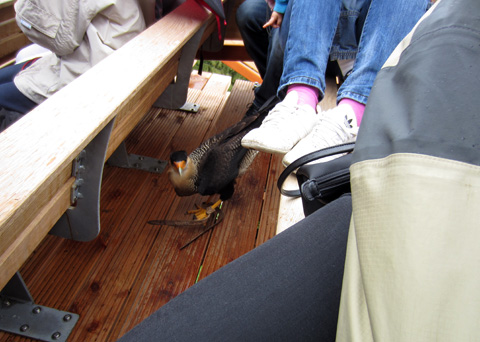
So welcome to the Castle of the Weird and Wild. Before you go…let’s take one more walk on the the weird side.

While strolling around the castle grounds, you might come across this sign…
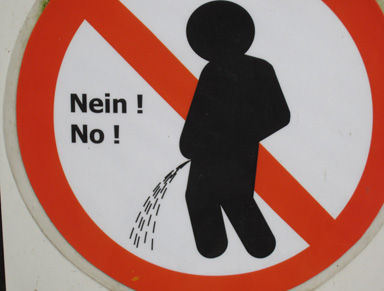
Is this really a problem???

Standard
Culture

5 More Funny German Words

As I continue my struggle to learn the German language, I’ve stumbled upon a few more words to add to my original list of Five Funny German Words.

No offense to speakers of this wonderful and challenging language, but to a person with a background in English… I find that certain words are worth a giggle.

5 More Funny German Words

Fahrtwind – I always get a kick out of Gute Fahrt. The phrase means Have a Great Trip, but it sounds like something else entirely (how perfect to see this phrase on a gas pump!). I recently looked up Fahrt in my German dictionary to check my interpretation …and lo and behold, I discovered another gem: Fahrtwind…the German word for airstream.

PuppenIf you say the Puppen out loud in English-speaking countries, thoughts in line with Fahrtwind may come to mind. The other day, I was strolling through the streets of a cute little German town with some friends. They spotted a sign that entertained them to no end: Puppenhaus. No…it wasn’t on an outhouse door…the sign referred to a House of Dolls and Puppets.

Handy – Here is a word that Germans would probably insist is English. Little do they know that we use this word in an entirely different way. If you ever drive in Germany, you may see signs that say Finger Vom Handy. The signs aren’t suggesting that you behave improperly with the handyman. They’re telling you to keep your hands off your cell phone.

Krank – This is the German word for sick. I think it’s perfect…when I’m sick, I’m definitely a Krank. And if I get really kranky, I am comforted knowing that I can be taken to the Krankenhaus (hospital) in a Krankenwagen (ambulance).

Kummerspeck – In all fairness, this word isn’t exactly used in everyday conversations, but I ran across it on the internet and just had to share. Kummerspeck refers to excess weight gained from emotional overeating. The literal translation?

Grief bacon.

I wonder what the German word is for Grief Ice Cream?

Standard
Culture

Liver and Storks, Please

What comes to mind when you think of France? Do you fantasize about wine, eclairs, and outdoor cafes? Cathedrals, towers, and great works of art? How about liver and storks?

No? 

Me neither.

But on a recent visit to Strasbourg, I found that while travelers may not have their minds on liver and storks, the French do.

Despite the fact that their city was founded during Roman times, was endlessly fought over by Germany and France, and has become a symbol of prosperity by hosting the European Parliament…despite all this, the locals seem fascinated with liver and storks.

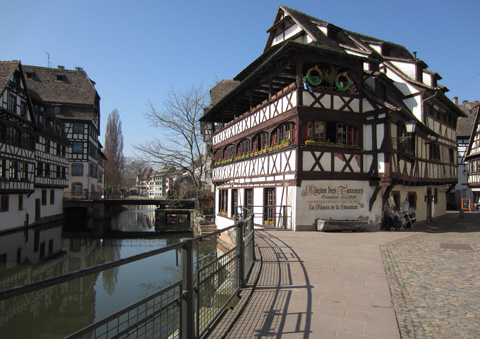
You might not notice it at first, since you will undoubtedly be awed by the great cathedral at the center of town, a building that for centuries was the highest in all of Europe.

You will be swept onto the canals of Strasbourg and taken by boat through La Petite France (which, despite its modern romantic charm, is named for the hospital where soldiers were treated for venereal diseases contracted during the Italian wars).

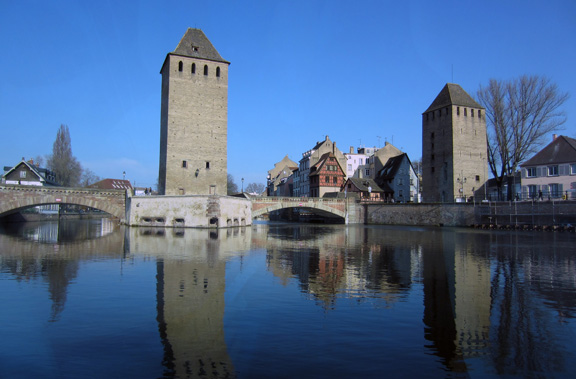
Then you will float by fourteenth century towers that protected the “Fortress on the Road” in medieval times.

But after you return from your boat tour, fill your belly with a traditional kougelhopf, and then take a closer look.

What are those things lining the streets that so elegantly frame the cathedral? Stuffed storks.

And what’s being served in restaurants and sold in fine food shops? Liver. Why?

Well, it seems that in the Alsatian region of France, where Strasbourg is located, storks have been longtime residents and are considered a symbol of happiness. The bird has spawned a tradition that you may not want to tell your kids: when a child wants a little brother or sister, she can set a piece of sugar on the window ledge to bribe the stork, who we all know to be the bringer of babies.

It would seem that geese have not been as fortunate as their cousins. In Alsace, goose liver pate (foie gras) is a delicacy on the level of caviar. In the old days, geese used to be cruelly pinned down and force-fed in order to fatten up their livers. Now the EU has ensured that they are treated in a more humane way, but the dish continues to be highly sought after.

I don’t know about you, but I can’t think of anyone on my gift list who wouldn’t be thrilled if the souvenir I brought home from France was a tin of liver and a stuffed stork.

Excuse me…I have some shopping to do.

Standard
Culture

Startling Symbol of Brussels

Belgium makes you think of waffles. Right?

Perhaps you might think the symbol of Brussels, Belgium’s capital and largest city, would be a waffle.

I did. I mean, no city would represent itself with a brussel sprout, so what else could it be?

Granted, other cities use impressive structures for their symbols. Paris has the Eiffel Tower, St. Louis has the Arch, Seattle has the Space Needle.

Maybe the bigwigs in Brussels hoped the Atomium would be the symbol of their fine city.

But, alas, the local people had different ideas.

They chose a little bronze statue that’s part of a water fountain in downtown Brussels. The statue is only 24 inches high (much smaller than the replica above). And its name?

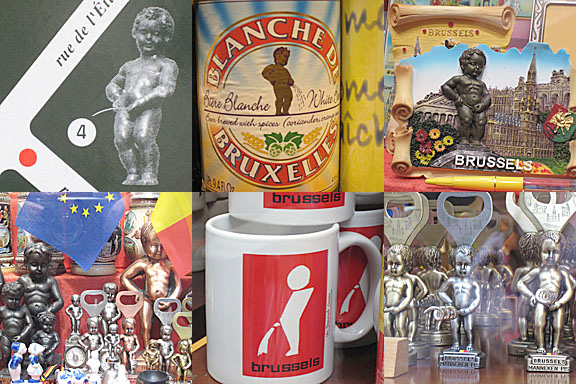
Manneken Pis…literally Little Man Pee:

The little guy with a big reputation has been around since the 1600s and has become the focal point for a lot of tourist memorabilia:

Apparently if you stick around for 4 centuries, you acquire quite a large wardrobe. The statue is rumored to have over 800 outfits. The unveiling of each new costume draws as much attention as a New York fashion show. Check it out (the little guy has some reach):

Here is the rest of the first photo from above. Doesn’t it make you hungry for a waffle?

Standard
Culture

Five Funny German Words

Perhaps I’m a bit juvenile, but as an English speaker, certain German words give me pause. They just don’t mean what I think they should.

As I struggle to learn this new language, I find that because these words jump out at me, I’ve learned their meaning a lot quicker than I would have otherwise. Unfortunately, to other English speakers, my limited German vocabulary makes me sound like I have a bit of a foul mouth…

Five Funny German Words

Fahrt – As a traveler, I see this word frequently. I’m particularly entertained by signs that say Gute (Good) Fahrt or Über Fahrt. But the word does not mean what I think it does. Fahrt is German for ride, trip, or path. Often, it’s part of a bigger word, such as Ausfahrt, which you’ll see if you drive on the Autobahn…it refers to an exit ramp. (Alas…I think I’ll always get a kick out of Gute Fahrt).

Hell – If your mother-in-law walks into your house and says, “It’s hell in here,” don’t worry, she might not be insulting you. Hell is the German word for bright or light (Of course, if she doesn’t know that…).

Schmuck – You will often see this word on store windows. It doesn’t mean the shop is peddling your old boyfriends. Schmuck is the German word for jewelry. (Perhaps if your old boyfriend had given you Schmuck, you wouldn’t think of him this way).

Rathaus – This word is German for Town Hall. It’s a house where politicians hang out. I think this word is particularly appropriate now that election time is upon us once again.

Groß – The strange letter at the end of this word is the German way of writing a double ‘s’. This word is pronounced gross. The double meaning of this word has led to a popular joke: A woman sees a man peeing on a building. She exclaims, “Oh, gross!” The man tells her, “Thank you.” I think you can guess the meaning…

Standard