Travel

To Pee is Not Free

Growing up in the United States, I always knew I had certain unalienable rights: life, liberty, the pursuit of happiness, and the right to pee for free.

Not so in Europe.

Many establishments, such as grocery stores, don’t have public bathrooms at all.

Other places, like restaurants, have attendants sitting outside bathrooms with a little dish where you’re expected to leave a tip.

Still other places have completely commercialized the whole process. If you stop at a rest area on the Autobahn, expect to drop a few coins into a turnstile before you will be permitted entry. Instead of a train ticket, you get a voucher you can use towards a cup of coffee…talk about job security.

The going rate for pee breaks in Germany is 70 cents (in Euro), so if you’re planning to travel here, be sure to budget in potty tolls because to pee is not free!

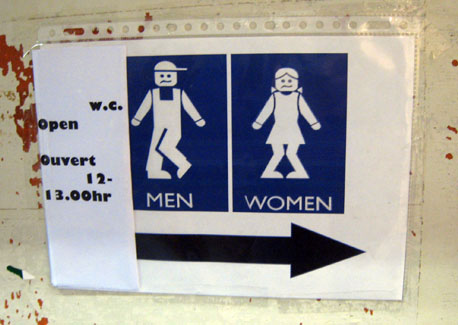
P.S. Take a good look at the photo above. Does this mean you’re only allowed to pee between noon and 1pm?

See more on this important subject:

First You Pee, Then You See

Standard
Culture

Five Funny German Words

Perhaps I’m a bit juvenile, but as an English speaker, certain German words give me pause. They just don’t mean what I think they should.

As I struggle to learn this new language, I find that because these words jump out at me, I’ve learned their meaning a lot quicker than I would have otherwise. Unfortunately, to other English speakers, my limited German vocabulary makes me sound like I have a bit of a foul mouth…

Five Funny German Words

Fahrt – As a traveler, I see this word frequently. I’m particularly entertained by signs that say Gute (Good) Fahrt or Über Fahrt. But the word does not mean what I think it does. Fahrt is German for ride, trip, or path. Often, it’s part of a bigger word, such as Ausfahrt, which you’ll see if you drive on the Autobahn…it refers to an exit ramp. (Alas…I think I’ll always get a kick out of Gute Fahrt).

Hell – If your mother-in-law walks into your house and says, “It’s hell in here,” don’t worry, she might not be insulting you. Hell is the German word for bright or light (Of course, if she doesn’t know that…).

Schmuck – You will often see this word on store windows. It doesn’t mean the shop is peddling your old boyfriends. Schmuck is the German word for jewelry. (Perhaps if your old boyfriend had given you Schmuck, you wouldn’t think of him this way).

Rathaus – This word is German for Town Hall. It’s a house where politicians hang out. I think this word is particularly appropriate now that election time is upon us once again.

Groß – The strange letter at the end of this word is the German way of writing a double ‘s’. This word is pronounced gross. The double meaning of this word has led to a popular joke: A woman sees a man peeing on a building. She exclaims, “Oh, gross!” The man tells her, “Thank you.” I think you can guess the meaning…

Standard
Culture

The Real Reason for Castles

As a newcomer to Europe, castles are a complete novelty to me. All my life, I imagined that castles were grand places where princesses held court, kings defended their people, and knights gathered at round tables. Now I know the truth.

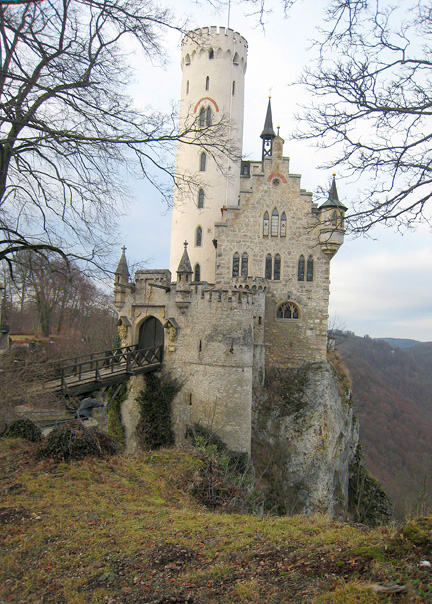
I recently visited this castle:

It’s called the Castle Lichtenstein and it’s located near Stuttgart, Germany. Since this was my very first European castle, I entered with the appropriate amount of wonder and awe. I was impressed by the grand library, the room filled with armor and scary-looking implements of war, and the chapel filled with ancient religious paintings and statues of saints.

But as the tour progressed, our guide led us further up into the castle and I discovered the real reason the castle had been built…

The Drinking Room (no photographs allowed!). Above the door to this room, was a sign our guide translated as:

Many more drown in beer and wine than in the Danube and in the Rhine.

Inside the room, a champagne glass hung from the ceiling that was taller than me and could hold three liters of alcohol. How many Germans did it take to drink from the glass?

Three. One to hold the glass, one to drink the champagne, and one to keep the drinker from falling over.

The castle’s drinking room hosted so many parties that an adjoining “pass out” room was needed. Here, the women slept in chair-like beds that kept them upright so they wouldn’t experience bed spins and wake up looking less than their best (I suppose drinking a little less wasn’t an option).

And where did the men sleep? I’m guessing that after a night of bawdy revelry, the women banished the men and made them sleep here…

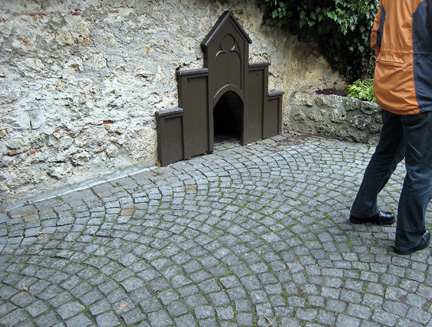
In the castle doghouse.

Standard
Culture

A Naughty Exhibit?

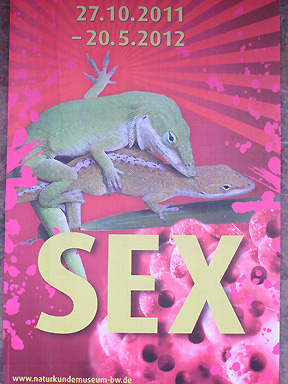
I didn’t use the word s-e-x in the title because I was afraid of sending your internet firewall into a tizzy.

But the poster on the left says it all…apparently, some words are the same whether written in German or English.

When it comes to this particular subject, there are two truths that are universally accepted…Europeans are more comfortable with their sexuality and more importantly, sex sells.

This exhibit is on display at the Nature Museum in Stuttgart, Germany until May 2012. I guess last year’s symposium on Coleoid Cephalopods Through Time just didn’t draw in the crowds, so this year the museum decided to try a different tactic.

I visited their website to find out more information and had to use Google’s Translate feature to read it. I think maybe something was lost in translation:

To the special exhibition, we offer an extensive program. Things to do in the public management program are special tours for couples, singles, men only, or women only.

Hmm…

Standard
Travel

Driving in Germany with a Bloody GPS

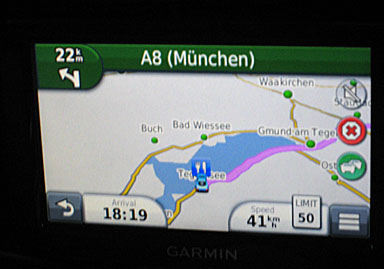
As a newcomer to Germany, I wouldn’t be able to make it around the street corner without my GPS. It’s truly a marvelous piece of modern technology. There’s only one problem…I don’t speak German. And now I’m realizing that I don’t speak English, either.

I mean English English – the kind Brits speak. The nice lady on my GPS tries very hard to pronounce German words with her British accent…and she fails miserably. This isn’t actually much of a problem since the Germans use microscopic print for their street name signs and I can’t read them anyway.

GPS Lady also gives the distance to the next turn in meters or kilometers, which is about as easy for me to visualize as the distance from here to Mars. On top of that, she occasionally uses British terms that are not part of my vocabulary. Every time I make a wrong turn, I expect her to say, “Oh, bugger and bullocks, now I have to do another bloody recalculation.”

So if you hear a story about a woman driving her car into a German beer garden, it’s probably just me trying to understand my GPS. By the way, can someone please tell me what a slip road is?

Standard